
THANK YOU FOR SUBSCRIBING

Gov CIO Outlook Weekly Brief
Be first to read the latest tech news, Industry Leader's Insights, and CIO interviews of medium and large enterprises exclusively from Gov CIO Outlook

 Julie Fink, President
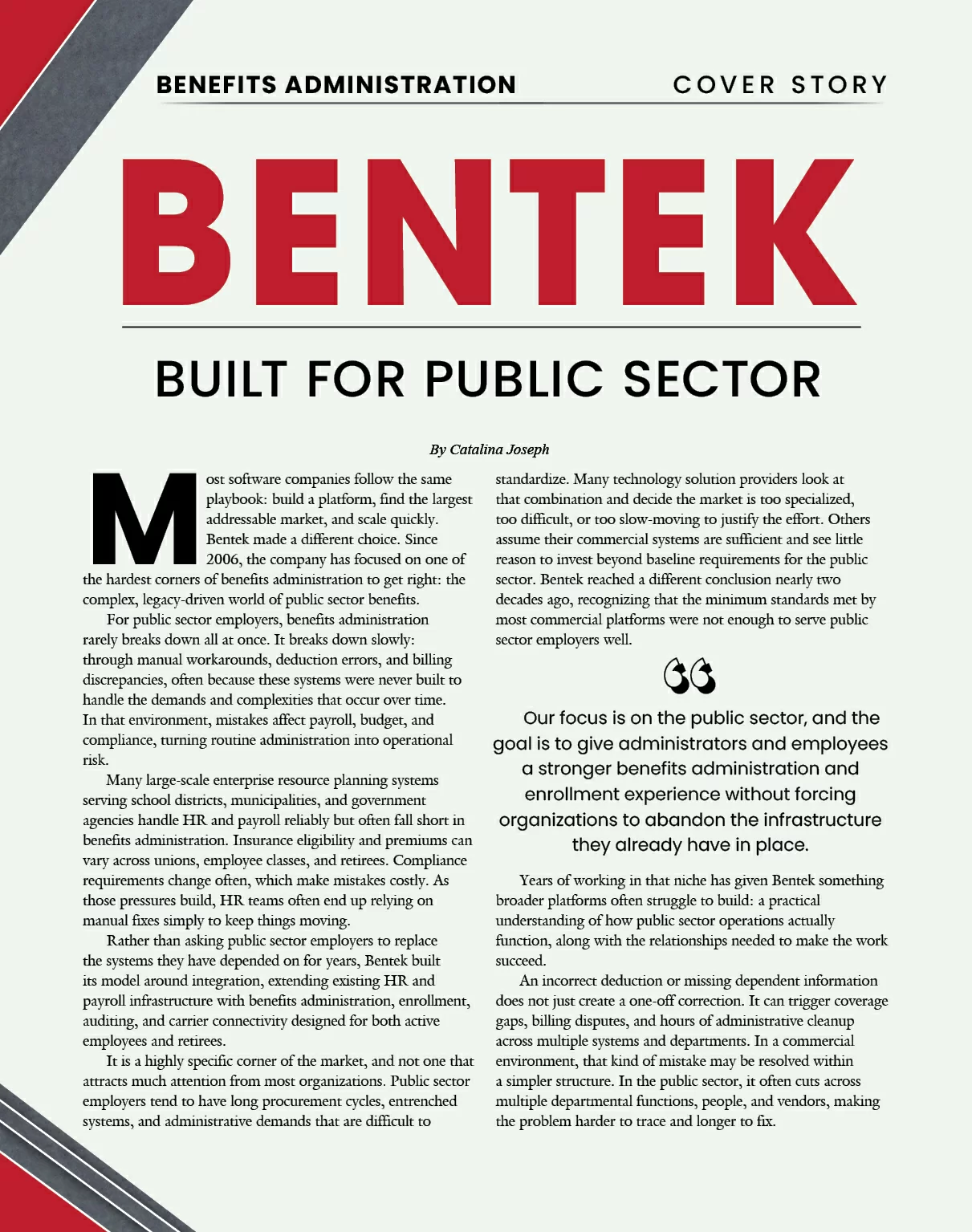
Most software companies follow the same playbook: build a platform, find the largest addressable market, and scale quickly. Bentek made a different choice. Since 2006, the company has focused on one of the hardest corners of benefits administration to get right: the complex, legacy-driven world of public sector benefits.
For public sector employers, benefits administration rarely breaks down all at once. It breaks down slowly: through manual workarounds, deduction errors, and billing discrepancies, often because these systems were never built to handle the demands and complexities that occur over time. In that environment, mistakes affect payroll, budget, and compliance, turning routine administration into operational risk.
Many large-scale enterprise resource planning systems serving school districts, municipalities, and government agencies handle HR and payroll reliably but often fall short in benefits administration. Insurance eligibility and premiums can vary across unions, employee classes, and retirees. Compliance requirements change often, which make mistakes costly. As those pressures build, HR teams often end up relying on manual fixes simply to keep things moving.
Rather than asking public sector employers to replace the systems they have depended on for years, Bentek built its model around integration, extending existing HR and payroll infrastructure with benefits administration, enrollment, auditing, and carrier connectivity designed for both active employees and retirees.
It is a highly specific corner of the market, and not one that attracts much attention from most organizations. Public sector employers tend to have long procurement cycles, entrenched systems, and administrative demands that are difficult to standardize. Many technology solution providers look at that combination and decide the market is too specialized, too difficult, or too slow-moving to justify the effort. Others assume their commercial systems are sufficient and see little reason to invest beyond baseline requirements for the public sector. Bentek reached a different conclusion nearly two decades ago, recognizing that the minimum standards met by most commercial platforms were not enough to serve public sector employers well.
Our focus is on the public sector, and the goal is to give administrators and employees a stronger benefits administration and enrollment experience without forcing organizations to abandon the infrastructure they already have in place.
Years of working in that niche has given Bentek something broader platforms often struggle to build: a practical understanding of how public sector operations actually function, along with the relationships needed to make the work succeed.
 An incorrect deduction or missing dependent information does not just create a one-off correction. It can trigger coverage gaps, billing disputes, and hours of administrative cleanup across multiple systems and departments. In a commercial environment, that kind of mistake may be resolved within a simpler structure. In the public sector, it often cuts across multiple departmental functions, people, and vendors, making the problem harder to trace and longer to fix.
For employees, that can mean an unexpected paycheck change, a delay in coverage, or a claim issue they discover only after the fact. For employers, it means a far more involved cleanup process, numerous vendors, and intricate compliance processes, often with limited staff time to spare. Bentek built its business around helping public sector teams avoid that kind of administrative burden.
That same specialization has also allowed Bentek to scale efficiently. For example, through its integration with Tyler Munis for the Government of the U.S. Virgin Islands, Bentek provided a centralized benefits administration system serving 60 agencies across three islands and covering approximately 30,000 members, including active employees, retirees, and dependents. The company also conducted an initial data audit, reconciling 3,000 monthly discrepancies and deduction errors and significant premium savings for the government. By replacing fragmented administration across separate systems with a single system of record, the project demonstrated Bentek’s ability to manage public sector complexity on a significant scale.
How does Bentek integrate with existing systems instead of replacing public sector infrastructure?
Julie Fink, president of Bentek, described the company’s mission as rooted in the public sector’s day-to-day reality. Instead of pushing agencies, school districts, and municipalities toward disruptive rip-and-replace decisions, Bentek works alongside the systems they already rely on, extending their capabilities and improving the experience for both administrators and employees. “Our focus is on the public sector,” Fink said, and the goal is to give “administrators and employees a stronger benefits administration and enrollment experience without forcing organizations to abandon the infrastructure they already have in place.”
Bentek does not approach the work like standard software deployment. It treats implementation as the point where change emerges. Each engagement begins with a full data sweep and preliminary audit, followed by deep discovery sessions, regular check-ins, documentation, testing, and staged validation. Specialized teams handle HR and payroll integration, carrier file setup, and security configuration, reflecting the fact that public sector benefits require a team with diverse expertise and an intentional approach.
Fink described the process in practical terms: “We meet clients where they are,” she said. The work starts with understanding a client’s current state, including existing processes and pain points, then demonstrating how the platform is designed to streamline and enable best practices. Our goal is to leverage the platform’s flexibility, automation, and integration to eliminate redundancy, reduce errors, and redesign processes to deliver confidence and peace of mind. Fink also emphasized that Bentek is not handing over a tool and asking clients to build the system themselves. Clients benefit from a seamless experience, as Bentek’s team manages the details, provides clear project plans, and maintains weekly check-ins that foster transparency and ongoing collaboration. By taking on the complex tasks of system configuration during both initial implementation and renewal periods, Bentek enables public employers to maximize their resources and reduce administrative burden.
The Fond du Lac School District in Wisconsin offers a useful example of what that approach looks like in practice. Before working with Bentek, the district relied on paper-based enrollment, daily manual carrier portal updates, and payroll processes that left room for discrepancies. Bentek redesigned those workflows, moved the district to an online experience for enrollment, automated carrier feeds, integration with Skyward HR/Payroll, and used phased auditing to catch issues before they compounded. The result was full participation across 1,200 employees, zero manual carrier updates during open enrollment, and what district administrator Mike Gerlach described as the smoothest implementation the district had ever experienced.
Why Auditing Matters
Why is continuous auditing critical in maintaining accurate benefits administration and compliance?
One of Bentek’s most important capabilities is also one of the least flashy: auditing. During discovery and implementation, the company often finds a gap between how benefits are supposed to work on paper and how they function in practice. Payroll deductions may not align. Eligibility rules may be applied inconsistently. Ineligible dependents may remain covered because internal teams do not have the time or staff to continuously audit what is happening across systems.
It is also where the company’s service model proves its value. Bentek is not just selling software and disappearing after go-live. Once implementation is complete, public-sector teams still need support from people who understand them, their configuration, their benefits program and the administrative context. Bentek’s client success model is built around that reality, providing continued service, training, best practices, renewal planning, technical support and enrollment configuration each year. The company’s impressive 98.5 percent client retention rate demonstrates just how effective this approach has been.
Built by People Who Know the Work
In what ways does domain expertise improve outcomes in public sector benefits administration?
Another part of Bentek’s advantage comes from the people behind the platform. Many members of the company’s team have prior experience in government agencies, insurance carriers, or HR departments. The company also reports an average employee tenure of seven years, with many employees having been there since early years. In the software space where turnover is constant and institutional knowledge evaporates fast, that kind of continuity matters. It means clients are not repeatedly being handed off to people who are still learning the basics of the market.
 Fink also highlighted how the team's own backgrounds add significant value. Some members previously worked in HR roles for public sector organizations, while others came from insurance companies or payroll services. Their direct experience shapes many decisions within the company, influencing everything from platform development to our consultative support approach. In the complex, procedure-driven world of public sector benefits administration, this knowledge is particularly impactful.
Bentek has also expanded that relationship beyond the platform itself with annual client summits and HIVE user groups, giving clients opportunities to exchange ideas, share best practices and deepen their familiarity with the system. In a market where administrative teams are often stretched thin, that kind of ongoing education and peer connection can matter nearly as much as the technology itself.
Security, Trust, and the Next Phase
In public sector benefits administration, security is central to credibility. Employers not only need a platform that can manage complexity, but also one they can trust with sensitive private personal data. Bentek points to its SOC 2 compliance, A+ HIPAA rating and participation in the GovRAMP certification program as signals of trustworthiness in a market where data stewardship and operational reliability matter as much as functionality.
Bentek’s next phase is less about adding noise and more about tightening execution. The company is focused on using AI where it can make a measurable difference: streamlining internal processes, strengthening analytics and reporting, and adopting better tools to manage work. At the same time, Bentek sees continued growth through its public-sector focused partnerships and its expanding presence in the education market.
Fink has said the goal is for Bentek to be the first name public sector organizations think of when they begin looking for a platform to manage benefits. Building on extensive experience in a market often overlooked by other vendors, Bentek is leveraging its deep expertise to expand its reach and visibility. Looking ahead to 2026, the company anticipates significant growth through carefully selected strategic partnerships. These collaborations are expected to accelerate Bentek’s momentum and help solidify its position as the go-to solution for public sector benefits administration across the country. Ultimately, Bentek aims to become a household name in the industry, ensuring that when public sector employers think about benefits management, Bentek is top of mind.

Company
Bentek
Management
Julie Fink, President
Description
Bentek Benefits Technology helps public sector employers modernize benefits administration through configurable platforms, seamless payroll integrations, and collaborative implementation. By combining industry expertise with client-driven innovation, the company simplifies complex processes and delivers a more reliable, efficient benefits experience for administrators and employees.