
THANK YOU FOR SUBSCRIBING

Gov CIO Outlook Weekly Brief
Be first to read the latest tech news, Industry Leader's Insights, and CIO interviews of medium and large enterprises exclusively from Gov CIO Outlook

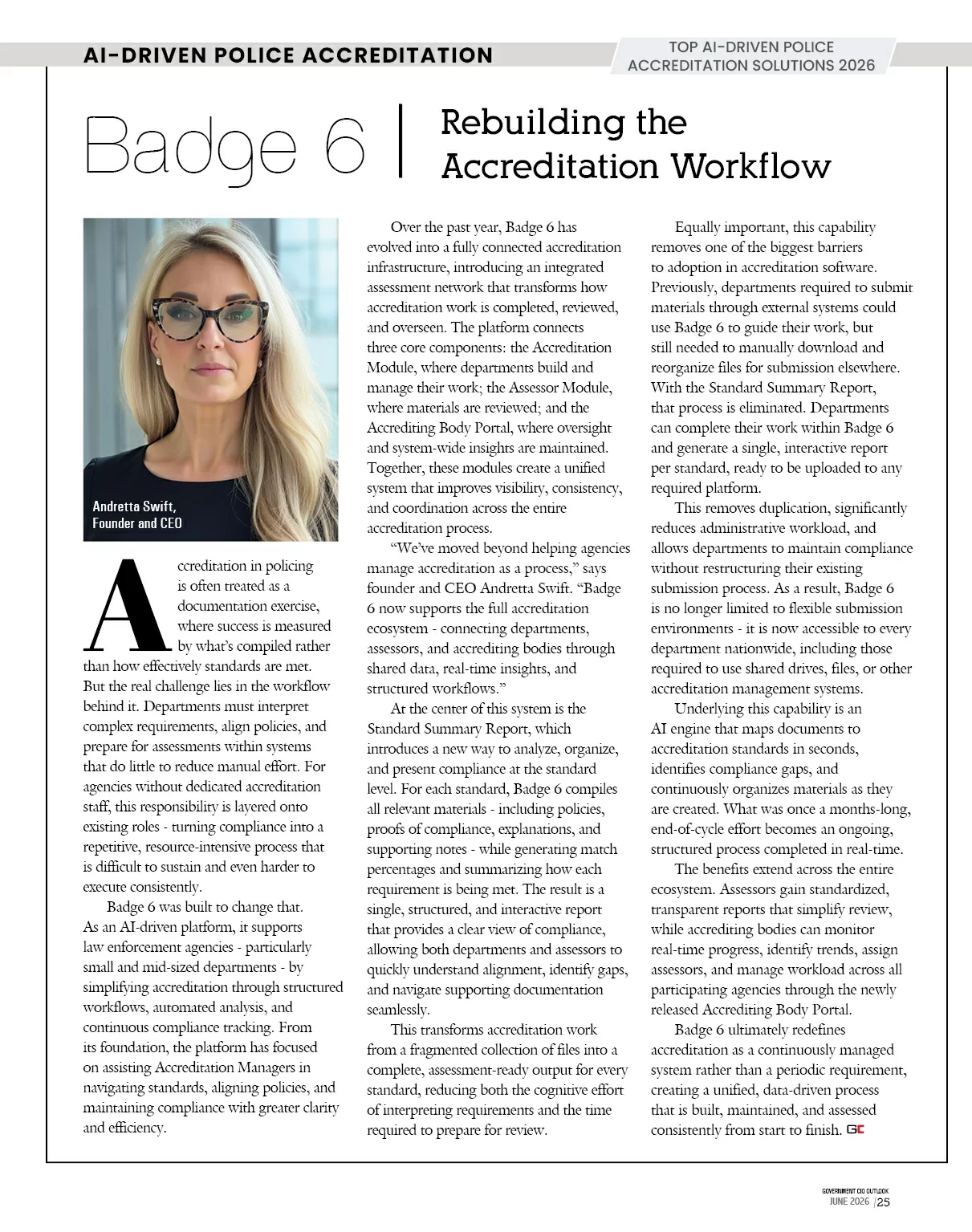
 Andretta Swift, Founder and CEO
Accreditation in policing is often treated as a documentation exercise, where success is measured by what’s compiled rather than how effectively standards are met. But the real challenge lies in the workflow behind it. Departments must interpret complex requirements, align policies, and prepare for assessments within systems that do little to reduce manual effort. For agencies without dedicated accreditation staff, this responsibility is layered onto existing roles - turning compliance into a repetitive, resource-intensive process that is difficult to sustain and even harder to execute consistently.
Badge 6 was built to change that. As an AI-driven platform, it supports law enforcement agencies - particularly small and mid-sized departments - by simplifying accreditation through structured workflows, automated analysis, and continuous compliance tracking. From its foundation, the platform has focused on assisting Accreditation Managers in navigating standards, aligning policies, and maintaining compliance with greater clarity and efficiency.
How does an integrated accreditation infrastructure improve coordination between departments, assessors, and oversight bodies?
Over the past year, Badge 6 has evolved into a fully connected accreditation infrastructure, introducing an integrated assessment network that transforms how accreditation work is completed, reviewed, and overseen. The platform connects three core components: the Accreditation Module, where departments build and manage their work; the Assessor Module, where materials are reviewed; and the Accrediting Body Portal, where oversight and system-wide insights are maintained. Together, these modules create a unified system that improves visibility, consistency, and coordination across the entire accreditation process.
“We’ve moved beyond helping agencies manage accreditation as a process,” says founder and CEO Andretta Swift. “Badge 6 now supports the full accreditation ecosystem - connecting departments, assessors, and accrediting bodies through shared data, real-time insights, and structured workflows.”
Why is standard-level reporting important for improving clarity and efficiency in accreditation processes?
At the center of this system is the Standard Summary Report, which introduces a new way to analyze, organize, and present compliance at the standard level. For each standard, Badge 6 compiles all relevant materials - including policies, proofs of compliance, explanations, and supporting notes - while generating match percentages and summarizing how each requirement is being met. The result is a single, structured, and interactive report that provides a clear view of compliance, allowing both departments and assessors to quickly understand alignment, identify gaps, and navigate supporting documentation seamlessly.
In what way does automation reduce administrative workload and improve compliance consistency across agencies?
Equally important, this capability removes one of the biggest barriers to adoption in accreditation software. Previously, departments required to submit materials through external systems could use Badge 6 to guide their work, but still needed to manually download and reorganize files for submission elsewhere. With the Standard Summary Report, that process is eliminated. Departments can complete their work within Badge 6 and generate a single, interactive report per standard, ready to be uploaded to any required platform.
This removes duplication, significantly reduces administrative workload, and allows departments to maintain compliance without restructuring their existing submission process. As a result, Badge 6 is no longer limited to flexible submission environments - it is now accessible to every department nationwide, including those required to use shared drives, files, or other accreditation management systems.
Underlying this capability is an AI engine that maps documents to accreditation standards in seconds, identifies compliance gaps, and continuously organizes materials as they are created. What was once a months-long, end-of-cycle effort becomes an ongoing, structured process completed in real-time.
The benefits extend across the entire ecosystem. Assessors gain standardized, transparent reports that simplify review, while accrediting bodies can monitor real-time progress, identify trends, assign assessors, and manage workload across all participating agencies through the newly released Accrediting Body Portal.
Badge 6 ultimately redefines accreditation as a continuously managed system rather than a periodic requirement, creating a unified, data-driven process that is built, maintained, and assessed consistently from start to finish.


Company
Badge 6
Management
Andretta Swift, Founder and CEO
Description
Badge 6 is an AI-driven accreditation infrastructure connecting departments, assessors, and accrediting bodies. It enables agencies to build, manage, and maintain compliance through structured workflows, real-time analysis, and standardized outputs - while supporting any submission requirement, making advanced accreditation technology accessible to every department nationwide.